Solving problems every tea drinker faces.
Exclusive subscriber benefits:
Receive four FREE quality ebooks worth $60
-
Save at least $5 during your first purchase
As consumers, we are spoilt for choice. There are myriads of tea products to choose from. Unfortunately, there are more bad teas than good teas. If we are not careful, we will be sold short.
One question that needs answering is this: Which tea beverage should you drink for maximum health benefits?
In a way, the answer is relatively simple. Scientists have identified catechins (pronounced CAT-akin) as the major compounds that are responsible for most of green tea's health benefits. They also found that the level of catechins correlates directly with its antioxidant benefits. Therefore, the more catechins your tea contains, the more beneficial it is to your health.
About half of catechins are epigallocatechin-gallate (EGCG), tea's most abundant and active antioxidant. In this article, you will learn which tea products contain the highest amounts of catechins and EGCG.
Choice #1: Bottled or Canned Green Tea
Bottled or canned teas have gained great popularity in recent years. Contrary to what beverage companies claim, they are NOT a healthy beverage for three reasons:
According to Rod Dashwood of Oregon State University, and to studies from other organizations, they contained only a fraction of the catechins found in regular tea.
Most products are heavily sweetened and have a significant number of calories. If you are on a diet program, you are much better off steeping regular tea which has zero calorie.
Products may contain a significant numbers of artificial flavorings (including sweeteners), colorings and preservatives. Those who drank large doses over many years were especially vulnerable, as are young children.
Bottled or Canned Tea - Why More Harmful Than Healthy
In addition, energy drinks such as Enviga contain many harmful ingredients that have been known to cause allergies and asthma, weaken bones and teeth, and even cause cancers. Some of these artificial ingredients are calcium lactate, phosphoric acid, potassium sorbate and potassium benzoate, aspartame, and ace-k.
A good bottled tea should taste good without the need for sweetening. It should contain high levels of catechins and EGCG. Until such a product exists, it is time for us to move on to the next type of tea!
Choice #2: Instant Green Tea Mix
Instant tea mix is great for making iced tea, as it doesn't require boiling water. These mixes usually come with added flavoring such as lemon, raspberry or honey. They can be sweetened or unsweetened.
If you read the label of any tea mix, you will find most are vague on their catechins content. The reason is simple. A 2007 report published by the US Department of Agriculture found that these tea powders contain only 10% of the catechins found in regular steeped tea.
To make matter worse, the extra processing steps involved in making tea powders could increase tea's fluoride content way beyond the level specified by US regulations. According to a widely publicized 2005 study, over many years this could result in skeletal fluorosis.
Instant Tea Powder Mix - Antioxidants and Fluoride
Choice #3: Decaffeinated Green Tea
For a tea to be legally labeled "decaffeinated" in the United States, 98% of the caffeine must be removed. This means one cup should contain less than 5 milligram of caffeine. For caffeine sensitive individuals, drinking decaffeinated tea may seem an ideal way to enjoy tea's health benefits without its side effects.
Unfortunately, things do not quite work out this way.
The most commonly available decaffeinated tea is "naturally decaffeinated". These are made using a chemical solvent called ethyl acetate.
A 2003 study conducted by the UCLA Center for Human Nutrition found that it contains only a third of the catechins found in regular tea. Regular tea contains 21 to 103 milligrams of catechins per gram. A decaf tea contains only 5 to 50 milligrams.
Decaffeinated Tea Warnings! Natural Versus CO2
Choice #4, #5: Tea Bag Versus Loose Tea
Tea bags were launched by Tetley in the UK in 1953. They were an immediate success. They are convenient and easy to brew. They are the most popular form of tea beverage in the West.
The population studies showing the many health benefits of green tea are conducted in Asia, where people drink loose tea. There is no evidence that drinking tea made from bags can give you sufficient long term health benefits.
Personally, I drink black tea from bags. But I seldom drink green tea from bags. The problems are manifold. It all boils down to two factors:
Low quality leaves. Most tea bags are made from CTC leaves. CTC stands for "crush, tear and curl". It is a process used primarily on low quality leaves.
Rapid deterioration. When making bagged tea, whole leaves are chopped, sliced and diced into small particles ranging from 0.2 to 1.5 millimeters. These are called fanning and dusts. This process causes catechins to lose freshness quickly.
This is the reason why brand manufacturers are busy adding flavors to make them taste better.
Loose Tea Vs. Tea Bags - 7 Reasons Why It's Better
Want to know which tea bag brands came out top in two separate laboratory tests? Visit Best Green Tea - 4 Studies Reveal Healthiest Brand.
Choice #6: Flavored Tea
A mistake tea newbies often make is assuming that all loose teas are equally healthy. This is far from true.
A 2007 report published by the US Department of Agriculture (USDA) compares nearly 400 foods for their flavonoid content. They found that flavored green tea contains only 43 milligrams of catechins per gram. This comes out to be a third of the catechins found in a regular unflavored tea.
This is hardly surprising. Every industry insider knows that high quality tea doesn't require any flavoring. If a tea has been flavored, then chances are it is not good enough to be a regular tea.
How a tea tastes is an indicator of its quality, and how much catechin and EGCG it has. When you buy an unflavored tea, you can judge its quality by how it tastes. You can always add your own honey, lemon or ginseng later if you so wish.
For further information about drinking your tea with additives, visit Tea FAQ forum.
Choice #7: Tea Buds Versus Tea Leaves
What is the difference between good and bad loose tea? If you are simply after the health benefits of tea, does it matter how it tastes?
A 2004 study conducted by the UK Institute of Food Research analyzes 191 green teas from 6 different countries to understand what the best teas have in common.
According to lead author Dr. Gwenaelle Le Gall, green tea can be harvested in spring, summer and autumn. The first flush in April or May yields the highest grade tea. The quality of the tea is assessed through its appearance, flavor and aroma. To quote Dr. Gall:
In general, high quality green tea is described as "delicate" or "sweet". The chemical constituents depends on different tea types.
The highest quality tea ... is reported to contain high amino acids. Sweetness is attributed to amino acids, especially theanine, which has the taste described as "unami" or "brothy", while the catechins and caffeine contribute to the astringency.
In other words, high quality tea tastes sweet and rich rather than tannic. You don't need to add any flavoring or sweetener. He went on to explain what distinguishes the high grade from the low grade:
The size (age) of the leaves is actually the main criterion for grading green tea, and unlike black tea, green tea quality is directly related to the grading.
Teas made of the youngest leaves and the bud are the most expensive.
In other words, you want to be drinking tea buds harvested in spring, not tea leaves, which are picked later in the same season.
Scientists in China and Japan have long known that catechin content decreases with leaf age. Young tea buds picked early in the season have the highest concentration of catechins and theanine. For centuries, they have been prized for their healing benefits and soothing effects.
Of course, the timing of harvests (whether the first or subsequent picks in spring) and leaf age (buds or leaves) are not the only two determinants of tea quality. Other factors such as mountain altitude, tea garden age, hand-harvesting and hand-roasting and storage are equally important.
Learn why the scientists single out the Chinese Dragon Well tea for praise in Best Tea Chemical Secrets.
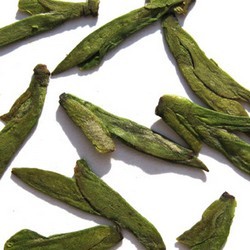 Imagine you are sipping the best green tea in the world.
Despite being a long time drinker of green tea, you are completely blown away. Never have you tasted something so fresh and full bodied, lightly floral and yet flavorful.
No matter what water temperature you use, the tea is always sweet and never bitter.
2-3 glasses mid morning leave you completely relaxed and energized for the day. Your palate feels very clean, silky and refreshed all day long. Your mind feels calm and concentrates very well with whatever task at hand.
This tea is called Tribute Dragon Well Tea. It is grown in the Lion Peak Mountain of Hangzhou, China. The Chinese White House - Zhong Nan Hai - sources 500 kilograms this tea yearly.
You can now buy this tea from this site at 100% purity.
Launched in 2006, she has accumulated nearly 170 raving reviews. Customers are saying that this is the best green tea they have ever had!
New! Comments: Like This Story? Leave A Comment!
Also In This Section...
Jasmine Tea Buyer's Guide - Which Is The Best Scented Tea?
As the most popular type of Chinese scented tea, jasmine tea has mesmerized tea drinkers for ages. How do you buy one? Why a pearl tea may not always be your best choice.
Advantages of Tea - Pros and Cons Review
What are the advantages and disadvantages of drinking this special tea? How does it compare to other therapeutic food?
Tea Nutrition and Calories - Better Than a Vitamin Supplement?
Would you like to know why green tea is sometimes referred to as the elixir of life?
Tea Information - Five Key Facts Everyone Should Know
Not quite sure what green tea is? Here are the essential facts to get you started!
Tea Facts - Score Yourself Out of 7!
7 important facts are presented below - do you know the answers to the questions?
Healthiest Tea - What Manufacturers Would Rather You Not Know
Which is the healthiest tea to drink? There are 4 different types: instant or bottled, flavored, decaffeinated and regular, which is the best?
Tea Vs. Coffee - Century Old Debate Continues...
Which is better? An objective analysis of the pros and cons of these two most widely consumed beverages.
Tea Antioxidant Debate - Green Tea Vs. Black Tea
Which tea antioxidant is better for you - green tea or black tea? The answer is surprising simple, but many experts still don't get it.
Tea Storage - Guarding Against The Five Thieves
Tea storage is tricky, but it is well worth the effort. You don't need to invest in any special equipment, some simple guidelines will go a long way.
How to Make Tea - Brewing Secrets FAQ Guide
Want to learn how to make green tea? Do you know that how you pour water has an important effect on the quality of your brew?
Tea is not just for drinking. Ten practical alternative uses to get the most out of left over or used tea leaves.
Green tea contains more chlorophyll than oolong and black tea.
Tea Store - A Secret Friend Offer
In this tea shop, you have secret friends in China's finest tea gardens.
Do you have some tea drinking tips? Please DO tell!
Others who read this site will greatly appreciate it, too!
Submitting a tip or story is easy! Just fill out the form below and hit the submit button.
Thank you in advance for sharing!
Click on the links below.
Green Tea: Decaf versus Regular
My doctor has suggested I drink 3 cups of green tea daily for infertility. The more I read, the more I am confused on drinking caffeinated vs decaf green …
Chinese Green Tea versus Japanese and Indian
What is the real difference in term of quality and taste between Chinese and Japanese green tea? Also, what does Chinese green tea compared to Indian green …
Lipton, Bigeolow, Arizona Green Tea Not Healthy?
I've been drinking bagged green tea for the past year. I've read the tea reviews on the site and I understand that I should completely switch to loose …
Rooibos Tea Retail and Wholesale - SuffuseUSA
As part of our mission to introduce Rooibos herbal tea to health conscious consumers around the globe, we would like to offer you the opportunity to get …
How to Drink Tea
Tea should not be drank with sugar or milk.
If you boiled 3 cups of water and put 1/3 cup of sugar in it, is that healthy? NO, so how does adding …
Which Tea to Drink for Newbie?
I really want to turn from a coffee drinker to a tea drinker, ideally, green tea.
I am at high risk for cancers and would really like to start with …
Récolte Thé
Je ne sais jamais, quand j'achète du thé, l'époque de la récolte.
Je cherche du thé de printemps, et en France, chez les vendeurs de thé, on ne connais …
Yamamotoyama Tea - Is It Any Good?
OK, first of all I live in Brasil so you can imagine that I can't get high grade tea so easily I even tried to make my own tea by having some seeds of …
Kukicha and Hojicha- Low In Caffeine and Health Benefits?
Julian, what about Japanese kukicha and hojicha teas? Do they contain little caffeine? How about health benefits?
Answer:
Any tea contains some …
Theanine and EGCG Concentration In Tea
Hello! I'm Amelia from Hasanuddin University in Indonesia. I'm currently working on a research assignment about "the effects of green tea for a better …
Brew or Steep Green Tea For Long Time
I read somewhere that a good idea is to steep 3 green tea bags in 24 oz. of water for 10 min., then drink it throughout the day. I usually wait for it …
Green Tea Leave Color - Yellow?
I bought 50 grams of green tea and noticed some of the leave are yellowish in colour.
Shouldn't the green tea leave be green in colour?
Thank you. …
Indonesia Green Tea?
Where can I buy some Indonesian Green tea?
Answer:
I am not familiar with Indonesian green tea, so I can't say. Considering the quality, I tend to …
How Much or How Many Cups of Green Tea to Drink?
I heard that the benefits of green tea can be perceived only if you drink such amount as one liter per day, but otherwise I read about the risk of anemia. …
Can Green Tea Replace Water - A Healthy Substitute?
I stick to a strict workout of alternating days to work out different body parts and aerobic days. I eat a very nutritious diet of 6 small meals which …
Is Green Tea Kosher?
I would like to clarify if the green teas meet the kosher standards.
From what I am learning from your website, the leaves are either steamed or roasted …
Best Green Tea to Buy for Weight Loss and Health?
What is the best green tea for me to buy, as far as flavor and health benefits go?
Thanks Archie
Answer:
Hey Archie, the thing about green tea …
Tea Bags vs Loose Tea - How Much Antioxidants?
Is the antioxidant level in tea bags less than loose tea?
Answer:
Hey, the level of antioxidants in tea depends on many factors.
Generally speaking, …
Green Tea Balls from Frontier Natural - Any Advice
The green tea I buy in the States from Frontier Naturals got a new supplier about 4 months ago, and now the green tea comes in hard little dark balls which …
Tea Storage - Fresh For Less Than 3 Months?
A 2008 study conducted by Purdue University found that green tea powders degrade significantly in 3 months at various humidity levels.
Bottled green …
Green Tea Plant - Grow and Make Your Own Tea
I was able to buy some Camelia Sinensis seeds, and I want to know how should I handle the leaves so that I can make some green tea. Does it need some special …
Brewing Iced Tea - Loose Tea Leaves for 2 liters
I just bought some loose bulk gunpowder green tea. I want to brew 2 liters worth to cool and make iced tea. I was wondering how much to put in the tea …
Green Tea Bottles and Cans - Is Instant Tea Healthy?
Are the instant green teas that come in jugs, cans and bottles worth buying? Do they have any of the good qualities that you find in tea you brew yourself? …
Green Tea - Best Time for Drinking?
When is the best time to drink green tea, before or after meals?
Answer
Joyce, the key to remember about drinking a tea - such as black tea or …
Green Tea Questions
I have just started drinking green tea and have a few questions. How safe is it to lose weight? Can it lower blood sugar levels? When is it a best time …
Regular Green Tea vs. Loose Tea vs. Hot Tea
What is the difference between regular green tea, loose tea and hot tea? Which one's the healthiest and can I buy them at the local supermarket? Have any …
Green Tea Leaves - Size and Quality
Does the size of green tea leaves bear any relation to its quality? Is small or large leaves better?
Answer:
The best green tea is made from young …
Back to Top of Green Tea
Back to Amazing Green Tea Home
Copyright� 2006-2025 Amazing-Green-Tea.com. All rights reserved.