Solving problems every tea drinker faces.
Exclusive subscriber benefits:
Receive four FREE quality ebooks worth $60
-
Save at least $5 during your first purchase
Chinese oolong tea can be classified into four regions:
Taiwan oolong tea has a relatively short history. While China's oolong tea history can be traced back to 16th century, Taiwan didn't get started until 19th century.
Initially, they took most of their plants and processing techniques from the Fujian province.
Over time, they came to develop their own style, which now covers the widest spectrum of tastes and flavors of oolong tea.
I list below the 5 most important types of Taiwan oolong tea, in ascending order of oxidation.
| Name | Oxidation | Withering | Shape | Comments |
| Baozhong Tea | Light | Light | Long | Nearest to green tea |
| Dongding Tea (Tungting) | Medium | Medium | Half-Ball | Most famous Formosa tea |
| Gaoshan Tea (High Mountain) | Medium | Medium | Half-Ball | Grown in high altitude |
| Tieguanyin Tea (Iron Goddess) | Medium | Medium | Ball | Most popular type of oolong |
| Champagne Oolong | Heavy | Heavy | Long | Nearest to Red or Black tea |
Baozhong Tea
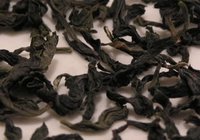
Also known as Qing Cha or Pouchong, it is characterized by low oxidation (8% to 18%), low withering (8% to 12%) and light rolling. It is the most green of oolong tea.
It was originally processed like the Wuyi Rock tea and is long and curly.
 It is classified
according to where it is grown. There are 3 varieties:
It is classified
according to where it is grown. There are 3 varieties:
Wenshan Baozhong tea is the single largest tea produced in Taiwan.
Dongding Tea
Perhaps the most famous of Taiwan oolong tea, it is also known as Tung Ting oolong tea.
It grows in Dongding Mountain (Frozen Peak) at 600 to 1,200 meters above sea level.
It is characterized by medium oxidation (15% to 25%), medium withering and medium rolling. It is half ball-shaped.
Authentic Dongding tea comes from a part of the Mountain called
Dongding Taidi. Properly speaking, only tea produced here can be called Dongding tea.
Tea grown outside the Taidi at lower altitude is called Dongjiao Cha (Frozen Leg Tea).
Gaoshan Tea
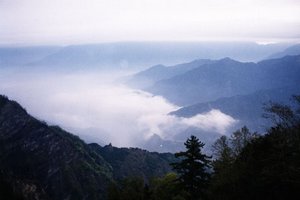
Like Dongding tea, Gaoshan tea too is characterized by medium oxidation, medium withering, medium rolling, and semi ball-shape.
Gaoshan means high mountain. Gaoshan tea grows at high altitude of 1,000 meters. The Gaoshan varieties consist of
Of which, Alishan tea is the priciest and most highly regarded.
Tieguanyin Tea
In Taiwan, Tieguanyin tea includes the entire family of ball-shaped oolong tea.
It is characterized by medium oxidation, medium withering and heavy rolling.
The two most well known varieties are
The Mu Zha variety is the most highly regarded.
Champagne Oolong Tea
The most exotic of oolong tea, Champagne Oolong is made of young tea shoots (one-bud-and-two-leaves) rather than the more matured leaves that other oolong teas typically use.
It is characterized by heavy oxidation (50% to 70%) and heavy withering (13% to 25%).
It is the closest thing oolong tea has to Chinese red tea.
It has many names:
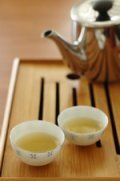 Champagne Oolong Tea
(Xiangbing)
Champagne Oolong Tea
(Xiangbing)It is customary to add a couple of drops of alcohol (champagne or Bailandi) to enhance its flavor.
The tea is made of very young leaves, which are covered with white hairs.
The tea is very expensive. People drinking it are thought to be a show-off.
According to a legend, Queen Elizabeth of England once remarked that the brightly colored tea liquor resembled a beautiful woman.
Since the tea comes from the East, it is called Oriental Beauty.
New! Comments: Like This Story? Leave A Comment!
References
Zheng Lisheng (2006). Wulong Cha Jianshang. Zhongguo Qinggongye Chubanshe.
Back to Top of Taiwan Oolong Tea
Back to Chinese Oolong Tea Main Page
Back to Amazing Green Tea Home
Copyright� 2006-2023 Amazing-Green-Tea.com. All rights reserved.