Solving problems every tea drinker faces.
Exclusive subscriber benefits:
Receive four FREE quality ebooks worth $60
-
Save at least $5 during your first purchase
How many times have you heard this before:
"With China becoming the manufacturing capital of the world, its environmental resources are increasingly under threat. Chinese tea is likely to be contaminated by pesticides and pollutants. Avoid them."
Do you agree?
Personally, I think it is too much a sweeping statement to make.
Here's why.
Chinese green tea is a complicated beast with many faces. To understand it, we need to know something about China itself.
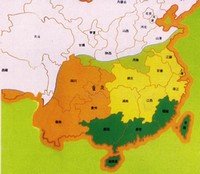 China is the third largest country in the world,
with land area slightly larger than the United States of America.
China is the third largest country in the world,
with land area slightly larger than the United States of America.
Unlike other tea-growing countries, Chinese green tea is cultivated in most parts of China.
In fact, about 20 out of the 30 provinces grow Chinese green tea.
The diverse growing conditions, tea species and processing methods give rise to thousands of varieties.
The cream of the crop is what is known as Mingyoucha, or Famous Superior Tea.
Gourmet Chinese Tea
These gourmet teas are found in areas of exceptional beauty, in mountains such as Lion Peak Mountain (Xi Hu Longjing tea), Yellow Mountain (Mao Feng tea) and Lu Shan (Misty Cloud tea).
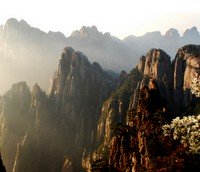 For hundreds of years,
local makers have developed sophisticated handicraft to optimize the quality of
these teas.
For hundreds of years,
local makers have developed sophisticated handicraft to optimize the quality of
these teas.
They are highly organic. Pests are naturally disinterested in tea plants; in these parts of China, there is simply no need to spray pesticides.
Chinese tea experts estimate there are around 700 different varieties of these gourmet teas.
It is a truly staggering number. No wonder tea experts always lament there are too many names to remember in one lifetime.
If experts who spent 4 years in university and wrote dozens of tea books say that, then the rest of us don’t stand a chance.
Luckily, most of these teas are rare. For all practical purposes, it makes sense to focus only on the superstars.
Here is the reason for misconceptions: you can seldom buy high grade Chinese tea in the West.
But I want you to have the quintessential experience of sampling them.
1. Xihu Longjing Tea (West Lake Dragon Well Tea)
2. Dongting Biluochun Tea (Green Snail Tea)
3. Huangshan Maofeng Tea (Yellow Mountain Fury Peak Tea)
4. Taiping Houkui Tea (Monkey Chief Tea)
5. And more to come ...
What makes them shine? Three reasons: early cropping, sophisticated handicraft and tribute tea heritage.
Early Cropping
When buying, it is important to know exactly when it is picked.
Most tea vendors label premium green tea as Mingqian (Pre-Ming), which means picked before 5 April. Sadly, this no longer works for some teas. late Pre-Ming tea can taste bitter. Global warming or not, the season has shifted forward.
In China, early harvested tea tends to fetch the highest price. They are higher grade and is known as delicate tender tea (Xinencha).
They usually consist of a terminal bud with up to two adjacent leaves.
One kilogram can have as many as 100,000 tea shoots. It takes a good picker half a day to harvest them.
For hundreds of years, these young tea shoots are the most prized collection of tea plants. It is worth every penny: they are the tastiest and healthiest.
Why Tender Tea Shoots Make The Best Green Tea
Green Tea Harvesting - The Art of Picking Gourmet Green Tea
Sophisticated Handicraft
While soil and climate play an important role, it is the tea-making process that brings the best out these precious tea shoots.
Most teas you buy in supermarkets and online are machine harvested and roasted. This the norm, and increasingly so. But not so for the best of the best Chinese green tea.
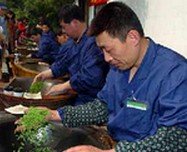 They are still
entirely handpicked and handroasted, the hard way. It is not that China has too much excess labour to spare. The reason being machine still cannot meet the high standard required.
They are still
entirely handpicked and handroasted, the hard way. It is not that China has too much excess labour to spare. The reason being machine still cannot meet the high standard required.
Imagine. A novice takes 3 years to master the 10 distinct hands movements of roasting Longjing tea.
After that, they can fry only 1 kilogram of high grade Longjing tea a day.
That is why authentic green tea tastes so much better than fakes. They can grow the tea plants somewhere, but they won’t be able to copy the roasting skill.
What are the advantages and disadvantages of the different firing methods?
Read Chinese Green Tea Processing to find out.
Tribute Heritage
Many Chinese teas are ex Gong Cha, or Tribute tea. They were made for the consumption of emperors.
The tribute tea system made tea an opulent luxury for the aristocrats, but brought on misery for the peasants.
It was as tragic as it ultimately would be glorious. The tribute tea heritage makes Chinese green tea arguably the finest in the world.
In the world where cultural heritage is increasingly obsolete and fading away, Chinese tea still shines like a Crown Jewel in the modern age for one simple reason - it appeals to the hearts and souls of we simple human beings - regardless of race, nationality and geography.
What Is Tribute Tea or Gong Cha?
New! Comments: Like This Story? Leave A Comment!
References
Chen Zhong Xian (1992). Zhongguo Chajing. Shanghai Wenhua Chubanshe.
Chen Qikun (2005). Zhongguo Lucha. Guangdong Luyou Chupanshe.
Photo at the courtesy of Xinhua news agency.
Wikipedia, The free encyclopedia. Chinese tea.
Related Articles
Emperor Shen Nong discover Chinese Green Tea 5,000 Years Ago?
Emperor Shen Nong is a myth, but the Chinese tea drinking habit does go back a very long way.
American Tea History - From Tea to Coffee
A beginner's guide to American tea history. Why does it take so long for Americans to discover loose-leaf?
How to Buy Green Tea In Spring
The best time to buy green tea is in the Spring. The earliest crops from the same tea garden are usually the finest, but the picking date alone does not tell the whole story.
Chinese tea tasting terminologies and classifications.
A rave by Man O Tea about his favorite tea.
Back to Top of Chinese Green Tea
Back to Amazing Green Tea Home
Copyright� 2006-2025 Amazing-Green-Tea.com. All rights reserved.