Tai Ping Hou Kui Tea
(Monkey Chief)
An Insider's Guide
What does the name of this fascinating tea mean?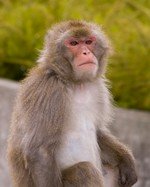
Tai Ping is the name of the county. Hou Kui is the name of the tea.
The tea is named after houkeng, the place where the tea was first made famous. Houkeng means Monkey Pit, so called because it is a mountain valley where people took shelter during wartime.
The word "Kui" comes from the name of the tea farmer - Wang Kui Chen - who invented it in the early 19th century.
Kui also means large or chief. High grade Chinese green tea is usually small and delicate. Not the Hou Kui tea. It is celebrated for its large leaves and buds.
Characteristics
Tai Ping Hou Kui tea gained celebrity status in 1915, when it won the gold medal in Panama Pacific International Exposition. It is the first tea to win an international award in Republican China.
It went on to be one of China's 10 famous teas in 1955.
 Today, the best
Tai Ping Hou Kui tea comes from the Sanhe village in the Yellow Mountain area.
The village has 3 main production areas: Houkeng, Hougang and Yanjiacun.
Today, the best
Tai Ping Hou Kui tea comes from the Sanhe village in the Yellow Mountain area.
The village has 3 main production areas: Houkeng, Hougang and Yanjiacun.
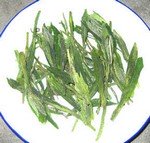
It is renowned for its "two knives and one pole": two straight leaves clasping the enormous bud with white hairs. The oven-made leaves are deep green in color with red veins underneath.
The tea shoots can be as long as 15 centimeters. They are plucked from the Shi Da Cha, a large leaf-variety found only in Anhui Province.
The tea has an orchid fragrance. The first infusion is said to be aromatic, second full bodied, 3rd and 4th pleasantly scented.
It is famous for the Monkey Rhyme (Hou Yun), a sweet aftertaste that can be found only in the best of Tai Ping Hou Kui tea.
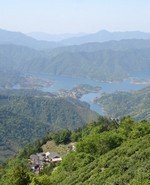
Houkeng forms part of the northern range of Yellow Mountain or Huangshan.
 The Yellow
Mountain is the tallest mountain in Eastern China, with 77 peaks above 1,000
meters. It is considered by the Chinese as the definitive of natural beauty.
The Yellow
Mountain is the tallest mountain in Eastern China, with 77 peaks above 1,000
meters. It is considered by the Chinese as the definitive of natural beauty.
It is a tea paradise. The Yellow Mountain area nurtures 4 of China's 10 Famous Teas: Tai Ping Hou Kui tea, Liu An Gua Pian tea , Huang Shan Mao Feng tea and the Keemun tea.
But it is not just the mountains, Hou Keng is surrounded by the Tai Ping Lake on the three sides.
Tai Ping means Great Peace. The Lake is not yet well known, but has recently been voted as the most scenic lake resort in China.
Tai Ping Hou Kui tea grows at an altitude of 500 to 750 meters. The tea plants are found in the hilly slopes of 25 to 40 degrees gradient. The temperate climate, plentiful rainfall and misty conditions combine to make it one of China's most exclusive teas.
Picking
Harvesting takes place once a year in Spring - for just 2 weeks.
Fancy the life of a tea farmer?
Picking starts when 20% of the tea shoots acquires one bud with 3 slightly unfurled leaves. Traditionally, this takes place around 20 April to 5 May. But climate changes have shifted the season forward.
Hou Kui tea an oddity in Eastern China. Delicateness and tenderness are not its strengths. To make it to the highest grade, the tea shoots have to be BIG.
The best Tai Ping Hou Kui tea grows in high places. The tea bushes are large with stout, straight stems and large, broad and thick leaves. Early picks are not necessarily the best.
After picking, the tea shoots are made by hand in the same day.
Making Process
Lianjian breaks off the top end of the tea shoots for further processing. A high grade can be 15 centimeters long, which is then baked to about 5 centimeters.
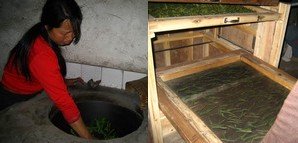
Shaqing applies low heat to a large wok to kill the enzymes and halt the fermentation process. The process lasts 2 to 3 minutes. The wok has a relatively constant temperature at around 110 degree Celsius.
Maohong, erhong and tuolaohong oven and press the leaves so that they are straight, flat and clasping the buds. Temperature reduces from 100 to 60 degree Celsius.
Varieties
Tai Ping Hou Kui tea is graded into 5 grades: Ultimate (Ji Pin), Special, First, Second and Third.
It belongs to a family of tea known as Jian Cha, or Pointed tea, which is found only in Anhui Province.
The best Tai Ping Hou Kui is grown in Houkeng, Hougang and Yanjiacun. Teas produced in the surrounding areas are called by the same name, but costs much less.
Falsification is rampant. Factories can produce symmetrical looking Hou Kui tea that looks even better than the authentic handmade variety. As far as we are aware, the local government has not issued any anti-fake certificate. If vendors are offering one, it probably doesn't mean anything.
To find a good Tai Ping Hou Kui tea, let your taste buds be your guide. Go for that unmissable Monkey Rhyme.
Photos were kindly provided by Hu, who owns a Monkey tea garden. His Houkui tea will be shipping in April 2009 and will be announced through my Newsletter.
References
Chen Zhong Xian (1992). Zhongguo Chajing. Shanghai Wenhua Chubanshe.
Back to Top of Tai Ping Hou Kui Tea
Back to Taiping Houkui Tea Main Page
Back to Tea Shop Main Page