Xihu Longjing
Tea
An Insider's Guide
The word Longjing means dragon well. This name can mean 3 things: a tea variety, a village and a well.
In the West, the tea is also known as Dragon Well tea or Lung Ching tea.
There are as many as 700 famous Chinese teas recorded in writings. Among them, Xihu Longjing tea is the most renown. It is often regarded as the Chinese National Tea.
What is so special about it? Four things stand out:
- Exceptional climate
- Imperial history
- Rigorous harvesting
- Traditional handicraft
To begin, let look’s at the place it was born - West Lake.
A popular tourist attraction, West Lake (Xihu) is a large fresh-water lake in Hangzhou, the capital city of the Zhejiang Province. It is just 180 kilometers from Shanghai.
It is a shopping mecca for silk, pearl, tea and Yixing tea pots. If you were to visit, remember to bargain hard and don't be afraid to slash prices.
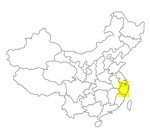 The tea growing region of West Lake consists
of 168 square kilometers of designated area. Only the tea grown here can be
called Xihu Longjing.
The tea growing region of West Lake consists
of 168 square kilometers of designated area. Only the tea grown here can be
called Xihu Longjing.
The oldest part of West Lake is in the villages surrounding the Lion Peak Mountain (Shifeng Shan).
They are known locally as the 4 villages of Weng, Long, Man and Yang. They are listed as the Grade 1 National Designated Protected Zone.
Many tourists mistook that the best tea comes from the Longjing village. Although it is one of the 4 villages, it does not necessarily produce the best tea.
The Xihu tea growing area was expanded twice - in the 1950s and then 1980s. Later additions include the larger Meijiawu and Longwu villages.
In summary, West Lake can be classified into three areas. In descending order of quality:
-
Lion Peak Mountain
-
Meijiawu
-
Others (often known simply as Xihu)
Tea plants thrive in plentiful rainfall, humid air, moderate climate and high altitude. They have it all in West Lake.
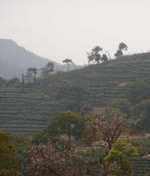 Climate is
moderate and averages around 16 degree Celsius.
Climate is
moderate and averages around 16 degree Celsius.
Rainfall averages 1,500 milliliters a year. It is especially plentiful in spring.
Humidity rules. The misty plantations is constantly shrouded in fogs and nourished by flowing streams.
The highest quality Xihu Longjing tea is found in the Lion Peak Mountain, which has an altitude of 1,000 feet above sea level.
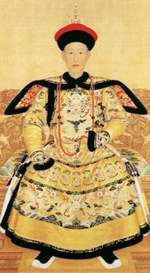
Longjing tea has long fascinated Chinese rulers.
The great Chinese Emperor Kangxi first makes it a tribute tea in the 17th century.
Then it was his grandson Qianlong.
He visited West Lake during one of his famous holidays to Southern China. When resting in the Hugong Temple under the Lion Peak Mountain, he was presented with a cup of Longjing tea.
In front of the Temple were 18 tea bushes. He was so impressed that he conferred to them the special status of “Imperial Trees”.
This was a rare event. There are very few imperial plants in China. These 18 bushes are now visited by thousands of tourists in West Lake each day.
Now, there are hundreds of tribute teas. Longjing tea was not the only one. But while other teas perished and were forgotten, Longjing's charms persist to modern China with Chairman Mao and Premier Zhou...
Both of them are very fond of it. They visited the West Lake tea gardens on numerous occasions.
The tradition of tribute tea continues until today. As far as I am aware, it is the only Chinese tea where the Chinese White House (Zhongnanhai) systematically collects in large quantity for their own consumption.
So now it is Mr. Hu Jintao and gang's turn...
And even former British Prime Minister Margaret Thatcher didn't miss out a chance to visit the tribute tea gardens, journeying all the way from Beijing to Hangzhou just so that she can see the tea!
It is quite rightly the most regal tea. No wonder it is sometimes called the Queen of Chinese Tea.
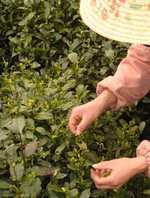 Xihu Longjing tea is only
harvested once a year in spring. The farmers leave the crop to recover for the
rest of the year.
Xihu Longjing tea is only
harvested once a year in spring. The farmers leave the crop to recover for the
rest of the year.
Traditionally, harvesting takes place from 20 March to 20 April. The earlier the harvest, the more tender the tea shoots, the higher the quality.
These early crops, available only in small quantity, make the best Xihu Longjing tea.
As the climate warms, leaves grow faster and are available in larger quantity, driving down the price.
Harvesting is a tedious process. Pickers have to exercise meticulous care to pick only the terminal bud and the 1 or 2 adjacent leaves.
Picking starts when the bud reaches 1 to 2 centimeter in length. The adjacent leaves should be no longer than the terminal bud.
Consistency and "cleanliness" are important. Each pick should be unbroken. Old leaves, fragments, fruits and other unwanted bits are rejected.
One kilogram of special grade Xihu Longjing tea can have 70,000 to 80,000 of Flags (Qiqiang) or one bud one leaf.
A good tea picker may harvest only 2 kilograms of fresh leaves in 10 hours, which are then processed into 500 grams of dried tea. It is a truly labor intensive process.
After picking, Xihu Longjing tea is roasted in the same day.
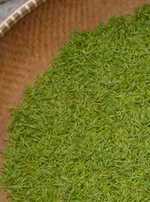 Withering. Pickers spread the tea leaves thinly
to dry for 8 to 10 hours.
Withering. Pickers spread the tea leaves thinly
to dry for 8 to 10 hours.
It removes 30% of the moisture, dissipates the grassy favor and reduces the bitter, astringent taste. It also increases the level of the yummy tasting theanine.
Roasting is done by bare hands to allow the roaster to feel the wok temperature.
A novice takes 3 years to master the 10 distinct hands movements of roasting Longjing tea. After that, they can fry only 1 kilogram of high grade Longjing tea a day.
Roasting consists of two parts: Qingguo and Huiguo.
Qingguo straightens, broadens and flattens the tea leaves into an attractive spear shape.
The process lasts 12 to 15 minutes. The wok temperature ranges from 80 to 100 degree Celsius.
About 100 grams are roasted until 25% of the moisture is left.
The tea is left to cool for 40 to 60 minutes.
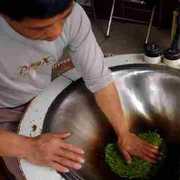 Huiguo dries the leaves further to prevent the
tea leaves from oxidizing.
Huiguo dries the leaves further to prevent the
tea leaves from oxidizing.
Young tea shoots are naturally covered by baby white hairs. The roaster smoothens the leaves by removing all fine hairs.
The process lasts 20 to 25 minutes. The wok temperature ranges from 60 to 70 degree Celsius.
About 250 grams are roasted until 5% of the moisture is left.
A chestnutty fragrance emerges. Leaves are cooked until they are flat, broad, straight, smooth, glossy and crispy. Yummy…
Lower grade Xihu Longjing tea follows a similar process. But roasting takes longer, wok is hotter and hand pressure is heavier.
New! Comments: Like This Story? Leave A Comment!
References
Chen Zhong Xian (1992). Zhongguo Chajing. Shanghai Wenhua Chubanshe.
Si Hai Gen (2000). ZhongGuo Mingcha Tupu: Luchapian. Shanghai Wenhua Chubanshe.
Back to Top of Longjing Tea
Back to Dragon Well Tea Main Page
Back to Tea Shop Main Page

