Bi Luo
Chun Tea (Pi
Lo
Chun)
Three Different Types To Know
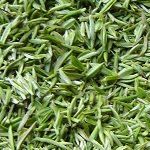 Bi Luo Chun tea is also known as Pi Lo Chun tea.
The name can be translated to Green Snail Spring, because it is a green tea that is rolled into a tight spiral resembling snail meat that is cropped in early spring.
Its original name is Scary Fragrance!
According to the Qing Dynasty chronicle Ye Shi Da Guan, Emperor Kangxi visited Great Lake (Tai Hu) in the 38th years of his rule. At that time, because of its rich aroma, local people called it Xia Sha Ren Xiang or Scary Fragrance.
Kangxi decided to give it a more civilized name - Bi Luo Chun. He was right, Bi Luo Chun tea is far from scary.
Characteristics
As you shall see later, there are at least 3 different types of Bi Luo Chun tea. The original variety is grown in the Dong Ting Mountain of Great Lake.
This variety is often described as smooth and fresh tasting with a sweet aftertaste. Unusual for green tea, it has a floral aroma and fruity flavor.
Tea experts have long regard it highly.
Zhen Jun (1857 to 1918 A.D.), author of tea encyclopedia Cha Shuo, ranked it first among Chinese green tea, before Longjing tea (second) and Liu An Gua Pian tea (third).
Dong Ting Mountain
This splendid mountain is located in Great Lake (Tai Hu) of Jiangsu Province in China.
With an area of 2,200 square kilometers, it is the third largest fresh water lake in China, located just 100 kilometers away from Shanghai.
It has some 90 islands and is an extremely popular tourist attraction.
There are, in fact, two mountains. The East Mountain is a peninsula. The West Mountain is an island in the Lake.
For those who have heard of the Four Beauties of China, well, the most beautiful of them all – Xi Shi – spent her summer holiday in the West Mountain.
Apparently the fish were so dazzled by her beauty that they forgot how to swim and sank to the bottom of the river!
Growing
The moderate climate, damp air and slightly acidic soil make Dong Ting Mountain a paradise for growing tea and fruit trees.
Dong Ting Mountain is renowned for producing fruits such as peach, pear, apricot, plum, persimmon, maidenhair and guava.
Fruit trees and tea bushes grow together, side by side, giving Bi Luo Chun tea a wonderful floral aroma and fruity flavor.
This unique growing condition is responsible for the small size of the Dong Ting tea bushes. The taller fruit trees shield them from summer heat and winter snow, giving Bi Luo Chun tea those tender and delicate leaves.
Making Process
Dong Ting Bi Luo Chun tea is handpicked, handsorted and handfired on the same day. The making process consists of three stages:
-
Picking (5 to 9 A.M.)
-
Sorting (9 A.M. To 3 P.M.)
-
Roasting (about 40 minutes)
Picking
Dong Ting Bi Luo Chun tea is only harvested once a year - in the spring. Harvest can begin in early March and continue throughout the Spring.
Grade is directly related to leaf age. The earlier the harvest, the smaller the tea buds, the higher the grade.
Picking any high grade Chinese green tea is a tedious process, and especially so for Pi Lo Chun tea. Each pick consists of a terminal bud with an adjacent leaf. A standard pick measures 1.6 to 2.0 centimeters.
One kilogram can have 14,000 to 15,000 tea shoots. It was said that the highest record ever known was 18,000.
Sorting
This tea is sorted by hand, one by one. The sorting process removes any sub standard leaves. A high quality should consist entirely of young tea buds and slightly opened leaves, and nothing else.
Roasting
Shaqing applies high heat to kill the enzymes and halt the oxidation, or fermentation process. The process lasts 3 to 5 minutes. The wok temperature ranges from 190 to 200 degree Celsius.
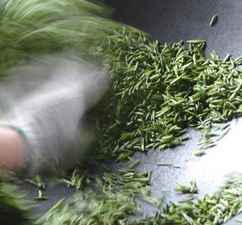
Rounian follows. Using 3 distinct hand movements, Pi Lo Chun tea is rolled into spirals. The process lasts 20 to 25 minutes. The wok temperature reduces to 70 - 75 degree Celsius. Moisture reduces to 30% to 40%.
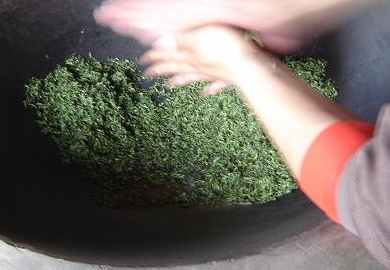
Cuotuan follows. Tea leaves spiral up and start to lump together. As color turns from green to gray, white hairs start to gather and show up.
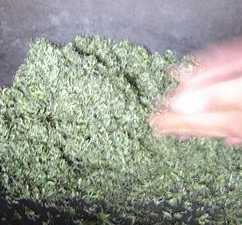
It might sound strange, but young tea shoots are naturally covered by baby white hairs. To many people, they are a sign of quality.
The process lasts 15 minutes. The wok temperature reduces to 50 - 60 degree Celsius. Moisture reduces to 20%.
Honggan applies low heat to dry the tea to about 7% moisture.
The process lasts 6 to 8 minutes. The wok temperature ranges from 30 to 40 degree Celsius.
Yes, they may look like some dark, curly snails but pop them into a glass of hot water and they will spring into life – bright green tea shoots – one by one.
Varieties
The original Pi Luo Chun tea is grown in the Dong Ting Mountain of the Jiangsu Province. The tea is famed for its delicate leaves and fruity flavor.
The Dong Ting Mountain is now granted the status of National Designated Protected Zone. It produces about 550 tonnes each year
 Due to its popularity, this tea
is now widely cultivated in other parts of Jiangsu Province such as Yi Xing, Li
Yang, Li Shui and Gao Chun. They produce about 1,500 tonnes each
year.
Due to its popularity, this tea
is now widely cultivated in other parts of Jiangsu Province such as Yi Xing, Li
Yang, Li Shui and Gao Chun. They produce about 1,500 tonnes each
year.
The tea making process is similar, but the Jiangsu Pi Lo Chun is larger, less delicate and less fruity than their Dong Ting cousin.
Pi Lo Chun tea is also grown in Zhejiang and Sichuan provinces. These are fake teas that are produced from other tea plant species.
Their leaves are larger and less uniform (may contain yellow leaves). They taste more nutty than fruity and smooth.
Ever wonder why the Biluochun tea is often considered China's No 2? After two years of searching, I have finally found an excellent Biluochun tea that I think you might like.
Biluochun Tea - Dongting and Zhejiang AAA Grade!
New! Comments: Like This Story? Leave A Comment!
References
Chen Zhong Xian (1992). Zhongguo Chajing. Shanghai Wenhua Chubanshe.
Back to Top of Bi Luo Chun Tea
Back to Biluochun Tea Main Page
Back to Tea Shop Main Page

