Solving problems every tea drinker faces.
Exclusive subscriber benefits:
Receive four FREE quality ebooks worth $60
-
Save at least $5 during your first purchase
Oolong Tea Information and Facts #1:
Also known
as wulong or wu-long tea
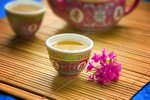 Oolong tea was first
exported from China to Europe in 19th century.
Oolong tea was first
exported from China to Europe in 19th century.
In 1979, China adopted a phonetic system called Han Yu Pin Yin, which uses Latin alphabets to represent sounds in Mandarin.
Under the new system, oolong tea is spelled as wulong or wu-long tea using the Latin alphabets.
That is why oolong tea is also known as wulong tea.
Oolong Tea Information and Facts #2:
Mainly
grown and consumed in China and Taiwan
Unlike green tea, which is grown in over 30 countries, oolong tea is mainly cultivated in Southern China and Taiwan, and more recently in India and Nepal.
It is widely consumed by the ethnic Chinese population in China, Taiwan, Hong Kong and the Southeast Asia.
According to Wu, black tea accounts for 77% of global tea consumption, green tea comes second at 21%, oolong tea comes last at 2%.
Oolong Tea Information and Facts #3:
Made
from more matured leaves
High grade greens are bud tea. They are made from very young tea shoots or buds.
These young tea shoots can be either a single bud, one-bud-and-one-leaf or one-bud-and-two-leaves.
Oolong teas and Indian black teas are considered leaf tea. They are made from more matured leaves.
The only exception is a Taiwanese oolong tea called Oriental Beauty, which is made from one-bud-and-two-leaves.
A standard oolong pick is one bud with 2 to 4 leaves.
Oolong Tea Information and Facts
#4:
Partially oxidised
Green tea is unoxidised. Black tea is fully oxidised.
Oxidation occurs when fresh tea leaves react with the oxygen molecules they come into contact with.
Oolong tea is semi-oxidised.
It is the most complex tea to process and can range from 10% to 70% oxidised.
Oolong Tea Information and Facts #5:
Complete
tea nutrients
According to Harold, oolong tea's chemical composition "would be expected to be intermediate between black tea and green tea".
It contains the full range of tea antioxidants: catechins (found in abundance in green tea), thearubigin and theaflavin (found in black tea).
To quote Harold:
It is probable, however, that oolong tea contains most of the components of black and green tea although in significantly different proportions.
If you are not drinking oolong tea, do so now. It is a useful addition to a diversified tea diet, and being a darker tea, is especially suited for autumn and winter consumption.
New! Comments: Like This Story? Leave A Comment!
References
McKay DL, Blumberg, JB. (2002). The role of tea in human heath: An update. J Am Coll Nutr 21:1-13.
Wu CD, Wei GX (2002). Tea as a functional food for oral health. Nutrition 18:443-444.
Harold N, Graham PD (1992). Green tea composition, consumption and polyphenol chemistry. Journal of preventive medicine and hygiene. 1992 May;21(3):334-50.
Related Articles
Green Tea Information - Five Key Facts Everyone Should Know
White Tea Information and Facts - Six Myths Debunked
Six white tea facts that tell you what many people don't. Is it the least processed tea? How to make a perfect cup of tea?
Back to Top of Oolong Tea Information
Back to Chinese Oolong Tea Main Page
Back to Amazing Green Tea Home
Copyright� 2006-2023 Amazing-Green-Tea.com. All rights reserved.