Huangshan Maofeng
Tea
(Yellow Mountain Fur Peak)
An Insider's Guide
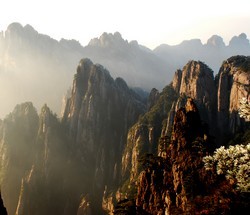 The word "yellow" carries a special significance in the Chinese psyche.
Yellow Emperor is reputed to be the Father of the Chinese people, widely regarded as the embodiment of the mythological golden era.
Yellow River is the cradle of the ancient Chinese civilization, flowing through the spine of the Chinese heartland. For millennia, she quietly witnessed the triumphs and troubles of her beloved people.
Is it a coincidence that the tallest mountain range of Eastern China is known as the Yellow Mountain - the very Mountain that has given birth to 4 of China's 10 Famous Teas?
Liuan Guapian (Melon Tea), Taiping Houkui (Monkey Tea) and Qimen Hong (Keemun Tea) are relatively young and were invented at around the turn of the 20th century.
So what is special about the Huangshan Maofeng tea - the only of the four golden siblings that bears the name of her Yellow Mother? To understand, we need to delve deeper into the origin of her name.
Characteristics
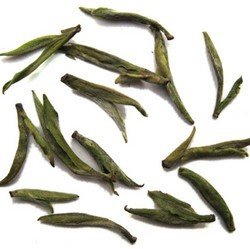 The word "Huangshan" means Yellow Mountain.
The word "mao" means hair, or fur. It refers to the silvery downy hairs that cover a pristine tea bud.
The word "feng" means mountain peak. It refers to the tippy end of a tea bud, which is so pointed that it resembles the sharp contour of a typical Yellow Mountain peak.
Chinese green tea can be classified into 9 basic shapes, and the Huangshan Maofeng tea is considered an Orchid shaped tea.
Grown in Anhui province, Orchid shaped teas are slightly curly. They are processed using a combination of roasting and ovening.
History
The story of this special tea is inseparable from her inventor - tea merchant Xie Zhengan, who inherited the tea company Xieyutai from his forefathers.
A major tycoon of his time, Xie Zhengan was a tea master in his own right. At around 1875, he selected tea buds from a village in Fuxi and started making Huangshan Maofeng. It was an instant success. He became the richest man in Yellow Mountain and went on to own nine tea shops around China.
(The tea company was subsequently brought down by trade embargo and his son's addiction to opium. In modern times, it has started trading again as a corporate entity.)
While Xie Zhengan's success has brought fame to this special tea, historians believe the cultivation of tea in the Yellow Mountain predates Xie Zhengan and may exist as early as Ming Dynasty.
During that time, she is known as the Yellow Mountain Cloud Mist tea (Huangshan Yunwu). Qing dynasty chronicle Suhu Bianlu rated her as No. 1 amongst all teas.
The high esteem in which Huangshan Maofeng tea is held by scholars explains why today she is regarded as the one of top 3 amongst Chinese green teas, ranking alongside Xihu Longjing and Dongting Biluochun.
Harvesting
 The tea-making process consists of four stages: harvesting, initial roasting (to halt oxidation), rolling and ovening.
As with all other high grade green teas, harvesting only takes place once a year, in spring. It consists of picking, sorting and withering.
Authentic teas are handpicked and made in the same day. Tea picked in the morning is made in the afternoon. Tea picked in the afternoon is made at night.
Roasting
Initial roasting is known as Shaqing. Wok temperature starts at 150 degree Celsius and is then reduced. Using their bare hands, the tea makers stir-fry the tea leaves, making about 60 hand movements every minute.
This is the most critical stage of the entire tea-making process. A well roasted tea has to be uniform, and neither raw nor burnt.
The initial roasting kills the tea enzymes and halts the oxidation process. The next task is to "roll" the leaves into the required shape. Again, bare hands and a hot wok are called for.
Ovening
Ovening is divided into two stages. The temperature starts at 90 degree Celsius and is reduced towards 60 degree Celsius.
In the first stage, the leaves are shuffled by hand to facilitate the drying process. It is a delicate process, as poor temperature control and hand movements could still lead to oxidation or "reddening".
Varieties
Huangshan Maofeng tea is now cultivated in the entire country, so it is meaningless to talk about any specific tea of this type, as it covers the entire spectrum of teas, both high and low grade.
Traditionally speaking, an authentic Huangshan Maofeng tea is known as a Teji, or special grade. Many people expect to buy an authentic tea from a reputable vendor and taste the real thing, but such a high grade is extremely rare.
Huangshan Maofeng tea is said to have originated in the deep mountain valley of the Fuxi villages, a few kilometers away from the Huangshan Scenic Area. The tea has become so popular and successful that by the early 1990s, thousands of tonnes were being produced in the Yellow Mountains.
What does a high grade look like? Here are some basic characteristics to watch out for:
-
Uniform Fur Peak. The tea buds should be pointed and covered by downy hairs. There should be a high degree of uniformity.
- Orchid fragrance. This seldom mention by experts, but Huangshan Maofeng has a characteristic orchid fragrance that is pure yet full "nose", making it very pleasant to drink.
In addition, the following may apply for a best grade:
-
Sparrow Tongue. Leaf style is one-bud-with-one-leaf.
-
Ivory Golden. Downy hairs cause the tea buds to appear ivory in color. Incidental leaves are golden in color.
New! Comments: Like This Story? Leave A Comment!
References
Chen Zhong Xian (1992). Zhongguo Chajing. Shanghai Wenhua Chubanshe.
Back to Top of Huangshan Maofeng Tea
Back to Maofeng Tea Main Page
Back to Tea Shop Main Page