Solving problems every tea drinker faces.
Exclusive subscriber benefits:
Receive four FREE quality ebooks worth $60
-
Save at least $5 during your first purchase
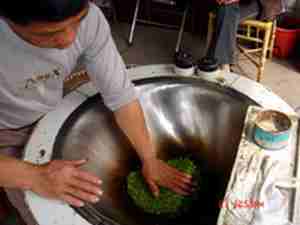
Unlike black tea, green tea is made with minimal oxidation. A process - called firing - applies high heat to kill the leaf enzymes to stop oxidation on its track, which resulted in the high catechins content of green tea.
The three firing methods account for the infinite varieties of green tea that exist in China and Japan today. All three methods were originally developed by the Chinese, as it long history affords it time to experiment and innovate.
Steaming
Steaming was widely used in Chinese green tea processing until the 16th century. It has regained popularity in recent years, especially for export to Japan.
Early Tribute teas were steamed. Japanese monk Kobo Daishi learnt this when he visited China in A.D. 804 and introduced tea drinking to Japan with the Chinese tea seeds he brought back. Today, the majority of Japanese green tea is steamed.
Advantages: Attractive "three greens": dried leaves, brewed liquor and brewed leaves.
Disadvantages: May smell grassy and taste bitter.
Roasting
Today, roasting or pan-firing is the most popular firing method for Chinese green tea. Like stir-frying Chinese food, the traditional handicraft uses an iron wok on a hot stove.
It was preferred over steaming for 2 reasons: it is quicker to roast and it smells better.
Using several distinct hands movements, a skillful roaster is able to handroast leaves into many different shapes using their bare hands. It is an incredible art form.
The three broad categories are long-roasting (Mei Cha), round-roasting (Zhu Cha or gunpowder green tea) and flat-roasting (Longjing tea, Da Fang tea).
Both Meicha (Hyson) (and Zhucha (Gunpowder) use mature leaves for processing and were developed for export to the Western world.
Advantages: Rich nutty aroma. Stunning varieties of shapes.
Disadvantages: Yellowish green coloration. Very brittle. May be fragmented, burned.
Baking
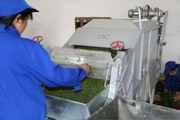 Baking can be done using either a charcoal or an electric oven. It is preferred over roasting when it is important to preserve the shape and
texture of the pre-processed tea, such as when making jasmine scented green tea.
Baking can be done using either a charcoal or an electric oven. It is preferred over roasting when it is important to preserve the shape and
texture of the pre-processed tea, such as when making jasmine scented green tea.
Floral and fruity green tea is usually baked rather than roasted.
Advantages: Well preserved. White hairs intact. Better coloration.
Disadvantage: Does not smell as good as roasting.
Many Chinese green tea processing is half-roasted and half-baked, allowing the advantages of each method to be exploited.
While most tea today is machine-made, the best Chinese green tea is still entirely handroasted, allowing the roasters to finetune the tea making process to optimize the quality of the individual leaves.
New! Comments: Like This Story? Leave A Comment!
References
Chen Zhong Xian (1992). Zhongguo Chajing. Shanghai Wenhua Chubanshe.
Related Articles
Green Tea Harvesting - Handpicking High Grade
What are the secrets of Chinese green tea harvesting? What separates the highest grade from the rest?
Oolong Tea Processing - A Beginner's Guide
Oolong tea processing has long been the a dark art of the Chinese tea masters.
White Tea Processing - Cool Way
White tea processing is fascinating. There is no heating and rolling. The tea-makers simply let nature takes its course.
Back to Top of Green Tea Processing
Back to Green Tea Main Page
Back to Amazing Green Tea Home
Copyright� 2006-2023 Amazing-Green-Tea.com. All rights reserved.